Today’s chapter of “Designing Immersive 3D Experiences” focuses on Ideation, and emphasizes that the start point of any MR design project is to identify what the product is, why you are creating it, and what problem it will solve for users. Any project simply made for its own sake, or made to use shiny new technology, will lack focus and fail to gain a user base. This reminds me of “Backward Design,” which I studied at an Online Class Design Course at Harvard Extension School. Developed by Grant Wiggins and Jay McTighe in their book “Understanding by Design,” Backward Design requires that teachers establish the learning goals of their course first, and then base all other elements of the class (lesson plans, learning activities, etc) around these goals. Establishing these goals makes for a more focused project, as the designer can focus on how best to teach the users/students, identify confusing parts of the content, and determine how to clarify those elements for better learning. For more information on Backwards Design, check out Mr. Wiggins explaining it in detail at Avenues: The World School YouTube channel.
After figuring out the “why” of a design project, Ms. Stevens suggests also determining the rest of the “Five W’s,” the Who, What, When, Where, and How of your project. Once those are established, the designer can brainstorm using divergent thinking. This involves coming up with multiple ideas for project concepts by thinking about random words in order to adjust thinking patterns and come up with ideas that the designer might not otherwise consider. Once a large pool of ideas is established, the designer narrows them down to just a few options using convergent thinking, combining ideas with commonalities and rejecting those that aren’t feasible. This chapter’s exercise follows a similar tactic, asking me to choose a random word and draw a “mind map” of association words linked to it. My word was “employee,” and I used it to create this mind map.
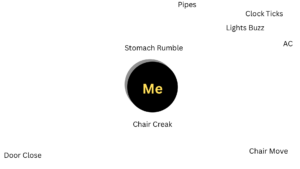
My map is based around my current work experience at Encore Global, and includes some of my daily tasks (set/strike, training), the names of my managers (Paul, Carl,) and the main focuses of the job (customer service, focus, clients.) I had limited time to complete this map, but I feel that if I used divergent thinking to expand the number of ideas, I could come up with a potential project for how to make day to day work at Encore easier.
Sources:
Bowen, Ryan. “Understanding by Design.” Vanderbilt University Center for Teaching,, cft.vanderbilt.edu/guides-sub-pages/understanding-by-design/. Accessed 9th August, 2023.
Stevens, Renee. Designing Immersive 3D Experiences. Pearson Education Inc., 2022. p. X.
Wiggins, Grant. “Grant Wiggins-Understanding by Design (1 of 2).” YouTube, uploaded by Avenues The World School, 7th May, 2013. https://www.youtube.com/watch?v=4isSHf3SBuQ&t=92s
Wiggins, Grant. “Grant Wiggins-Understanding by Design (2 of 2).” YouTube, uploaded by Avenues The World School, 7th May, 2013. https://www.youtube.com/watch?v=vgNODvvsgxM